The diffusion engine
See also: Diffusion (system overview) · Diffusion data flow · Parser cookbook & reference · Publication API · Exporting data
The diffusion engine is Dédalo's publication pipeline, built directly into
the work server (src/diffusion/): one engine in one codebase, driven by
the diffusion ontology, operated by the tool_diffusion client, and
producing the published artifacts — SQL tables and RDF / XML / Markdown /
CSV / JSON files. This page is the full technical reference: architecture,
lifecycle, formats, configuration. For the conceptual role of diffusion inside
Dédalo read Diffusion (system overview); for how
you decide what gets published read
Diffusion data flow.
Standing spec: engineering/DIFFUSION_SPEC.md.
Design in one sentence
One compiler, one resolver, one IR, many writers. A schema source (the dd1190 diffusion ontology, or a tool_export column set — both live) compiles into an executable
PublicationPlan; one streaming resolver turns plan + records into a typed intermediate representation; format writers are plugins that consume it and know nothing about ontology or resolution.
A little history: earlier Dédalo versions split publication across two runtimes
— resolution in the work server, parsing and MariaDB ownership in a separate
external engine — because that runtime could not sustain long publication runs.
In this server resolution is native, so that seam (per-record HTTP hops,
half-resolved wire payloads, a second public socket) is gone: what used to be a
runtime side-channel (merge_columns, global_table_maps, empty_to_string,
alias resolution, the virtual-tree walk itself) is now a compile-time plan
concept.
Architecture
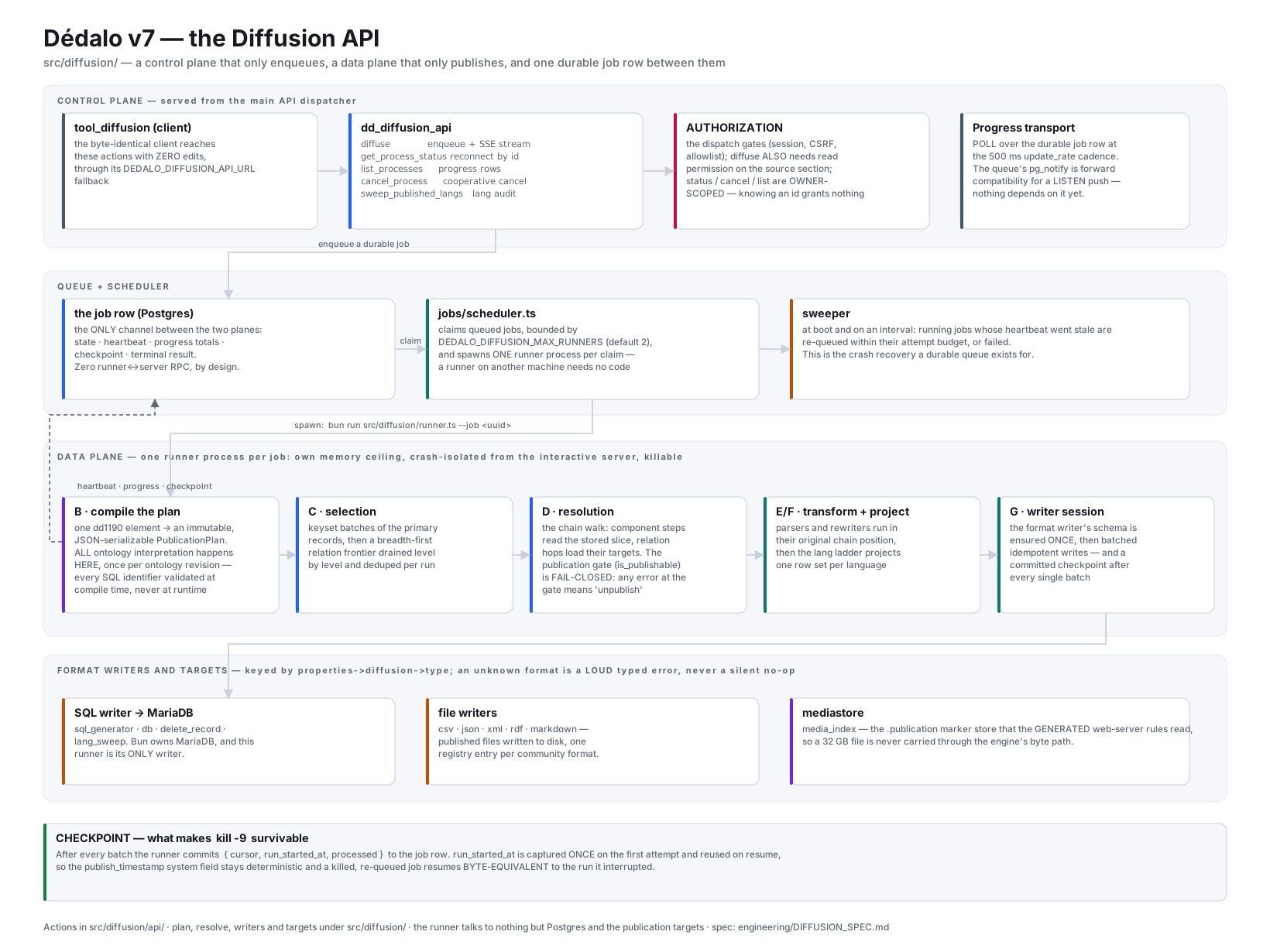
Click the diagram to open it full size; the Mermaid view below is the same architecture with the module names attached.
flowchart TB
    subgraph CLIENT ["Client (byte-identical tool_diffusion)"]
        TD[tool_diffusion.js<br/>publish / status / cancel / panels]
    end

    subgraph SERVER ["Main TS server — CONTROL PLANE"]
        API[dd_diffusion_api actions<br/>session + CSRF + allowlist + SEC-13]
        Q[(dedalo_ts_diffusion_jobs<br/>durable job queue, Postgres)]
        SSE[SSE streams<br/>poll the job row]
        SCHED[scheduler + sweeper]
    end

    subgraph RUNNER ["Spawned runner process — DATA PLANE"]
        PLAN[PublicationPlan<br/>compiled from dd1190, cached]
        RES[Resolver<br/>selection → chains → gate]
        TRF[Transform<br/>runtime parser registry]
        PRJ[Projection<br/>5-rung lang ladder + policies]
        WRT[Format writers<br/>sql · csv · json · markdown · rdf · xml]
    end

    subgraph TARGETS ["Publication targets"]
        MDB[(MariaDB<br/>publication databases)]
        FILES[/media path<br/>rdf · xml · md · csv · json files/]
    end

    TD -->|RQO diffuse| API --> Q
    SCHED -->|claim FOR UPDATE SKIP LOCKED| Q
    SCHED -->|Bun.spawn --job uuid --epoch n| RUNNER
    RUNNER -->|heartbeat · progress · checkpoint| Q
    Q --> SSE --> TD
    PLAN --> RES --> TRF --> PRJ --> WRT
    WRT --> MDB
    WRT --> FILES
Two planes, one codebase:
- Control plane (main server). All client actions dispatch through the
normal API gates.
diffuseenqueues a durable job and answers with an SSE stream that observes the job row — the stream is a view, not the run. - Data plane (runner process). A scheduler claims queued jobs
(
FOR UPDATE SKIP LOCKED, bounded byDEDALO_DIFFUSION_MAX_RUNNERS) and spawnsbun run src/diffusion/runner.ts --job <uuid> --epoch <attempt>: same codebase, its own process — own memory ceiling, crash-isolated from the interactive API, killable. The runner communicates exclusively through the job row (heartbeat, progress, checkpoint, terminal state) plus the targets. Because there is zero runner↔server RPC, a runner daemon on another machine can claim from the same queue — placement is deployment, not architecture.
The pipeline stages
| Stage | What happens | Module |
|---|---|---|
| A → B Compile | The dd1190 element subtree (flat virtual tree: aliases resolved in place, consumed branches suppressed, parents paths) compiles into an immutable, JSON-serializable PublicationPlan: per-section field plans, ddo-map trees with parent linkage, parser split, column typing, policies, lang + recursion policy. Cached per ontology revision; any dd_ontology write invalidates via the core cache-invalidation hub. |
src/diffusion/plan/{virtual_tree,compile,cache,types,identifier}.ts |
| C Selection | Keyset-batched cursor over the sanitized SQO (WHERE section_id > cursor ORDER BY section_id LIMIT batch; never OFFSET) + batched matrix reads (one IN query per batch). |
src/diffusion/resolve/selection.ts |
| D Resolution | Per record: publication gate first (fail-closed), then the recursive ddo-tree chain walk — the previous engine's resolve_chain twin: per-locator recursion, cross-section hops with batched term/typology prefetch, breadth-first frontier for linked-section publishing (levels budget + per-run dedup + cycle guard), rewriter semantics (parents, truncations, merge_columns, publication_unix_timestamp, …). Output: typed RecordIR with status: publish | unpublish. |
src/diffusion/resolve/{resolver,rewriters,default_value,record_ir}.ts |
| E Transform | The surviving runtime parsers run as pure functions over typed atoms — an exact port of the old parser-chain state machine, fed the same per-lang grouping. Unknown parser fn = loud compile error, never a silent skip. | src/diffusion/resolve/transform.ts, src/diffusion/parsers/ |
| F Projection | The 5-rung language ladder (exact → nolan → main lang → any → null) collapses each field per output language; empty_to_string / default_value policies apply here, in exactly one place. Output: ProjectedRow per lang. |
src/diffusion/project/lang_ladder.ts |
| G Write | The format writer for properties->diffusion->type consumes rows/records behind a fixed session contract: ensureSchema() once per run (serialized, outside row transactions), idempotent writeRows/removeRecords per batch, close() finalizes (merge/zip/counts). |
src/diffusion/writers/, src/diffusion/targets/mariadb/ |
| H Ledger | dd1758 activity rows (published per primary record), media markers, run report. |
src/core/resolve/diffusion_delete.ts (logDiffusionActivity) |
From the user's click to a published row
- Click. The (byte-identical) client builds the same RQO it always built —
{action:'diffuse', dd_api:'dd_diffusion_api', source, sqo, options}— and, withDEDALO_DIFFUSION_API_URLabsent from the environment payload, its own fallback posts it to the main API. - Gate + enqueue (milliseconds). Session, CSRF, action allowlist, read
permission on the source section (SEC-13). The SQO is sanitized at the
boundary; the plan is loaded from cache (or compiled — a bad parser fn or a
label that fails the SQL-identifier chokepoint dies here, loudly). A job
row is inserted; a partial-unique index guarantees one active run per
element + section — the same user repeating the same request attaches
to their running job instead of double-publishing; another user, or another
selection, on a target with an active run is refused with
diffusion.target_busy(409, retry when it finishes) and never sees the other run's progress. The HTTP response is the SSE stream. - Claim + spawn. The scheduler claims the job and spawns the runner process.
- The run. Schema-ensure once, then the streaming batch loop
(
DEDALO_DIFFUSION_BATCH_RECORDS, default 500 records/batch): select → resolve → transform → project → cancel-flag check → one fenced unit: the publication target's lock (a second writer of the same database or directory waits — the job shows Waiting for the publication target), the job's lease re-checked, batched writes (~200-row multi-row upserts, PK(section_id, lang)), then the dd1758 rows, the batch's run ledger events and the checkpoint{v: 2, cursor, run_started_at, processed, batch_seq, writer, errors}and the progress update (the user's bar moves), all committed together → next batch. Unpublishable records becomeremoveRecordscalls (the typed successor of the oldfields:'delete'sentinel); a record deleted from the archive while its batch waited is unpublished instead of written. - Finish / disconnect / crash. File formats merge + zip on
close(); the final SSE chunk carries the result (tables summary, orconsolidated_files+diffusion_datalinks for file runs). A closed browser changes nothing — the client reconnects later vialist_processes→get_process_statusby its deterministic process label. A dead runner is swept (stale heartbeat) and re-queued from its checkpoint (≤3 attempts). The resumed runner replays the job's run ledger — the relation frontier still to drain, the records already published, the files the run wrote — so its result, archives included, is byte-identical to an uninterrupted run's (gatetest/unit/diffusion_resume_ledger_native.test.ts: a crash among the primaries, a crash in the frontier drain, a crash inside a batch's tail, a realkill -9), and its report keeps the error lines the batches before the crash produced (Partial success). A linked record unpublished while the run was down is not republished by the resume: the drain asks the publication gate against the record as it is then. A cancelled run publishes no archive; an admin requeue resumes it. - Deletes (the reverse path).
section_record.delete()calls the diffusion hook in-process: MariaDB rows deleted natively (per-target isolation, missing table/database = idempotent success), files unlinked, failures ledgered as dd1758unpublish_pendingand retried on boot, opportunistically, or from the tool button. A diffusion failure never blocks the work-system delete.
The ontology contract
The engine consumes the v7 diffusion ontology exactly as it exists — it
never writes to dd_ontology and needs no migration:
| Ontology construct | Consumed as |
|---|---|
diffusion_domain / group / element[_alias] |
Element enumeration; properties->diffusion->{type, service_name} picks the writer + file service dir |
database[_alias] / table[_alias] node labels |
MariaDB database / table names — every one passes the SQL-identifier chokepoint (^[a-z][a-z0-9_]{0,63}$ after the oracle-parity sanitize) at compile time; rdf/xml labels are XML identities and are not SQL-sanitized |
*_alias nodes |
Resolved in place at compile: alias tipo/label win, properties inherit, the consumed real branch is suppressed (institution redirection keeps working) |
Field node properties->process->ddo_map |
Compiled to a ResolveStep tree with parent linkage (self resolution, auto-from-relations fallback, fn variants) |
properties->process->parser chains |
Split at compile: 10 rewriter fns are absorbed into plan structure (parents, get_locator, merge_columns, map_section_tipo_to_name, publication_unix_timestamp, truncations/filters/slices); 23 runtime fns run as pure value transforms — see the parser cookbook & reference for every fn with in→out examples. All 33 names stay resolvable; an unknown name fails validate loudly |
exclude_column, varchar/length/index, output_format, empty_to_string, default_value, preserve_order |
First-class FieldPlan / FieldPolicy / ColumnDef concepts (including the component-class output_format fallback: relation-family fields default to json) |
component_publication + ontology is_publishable |
The publication gate — evaluated per record, fail-closed (any gate error ⇒ unpublish) |
The admin-only validate action compiles an element and returns every error and
warning — the loud pre-run gate (missing service_name, invalid identifiers,
unknown parser fns, rewriter absorptions).
Formats
type |
Writer | Target & layout | Notes |
|---|---|---|---|
sql |
writers/mariadb_sql.ts |
MariaDB, one table per section; PK (section_id, lang); additive-only self-evolving schema (CREATE IF NOT EXISTS → INFORMATION_SCHEMA diff → ALTER ADD) |
True multi-row upserts (~200 rows, 4 MB budget); oracle-parity column typing/indexes/comments |
socrata |
alias of sql |
— | Dormant, as in the old engine |
csv |
writers/csv.ts |
<media>/csv/<db-or-service>/<table>.csv |
RFC 4180, streamed, header = plan column order |
json |
writers/json.ts |
<media>/json/…/<table>.ndjson + .meta.json sidecar |
One JSON object per row line |
markdown |
writers/markdown.ts |
<media>/markdown/<service>/<st>_<id>.md (+ zip) |
Same name grammar as the delete path, byte-pinned |
rdf |
writers/rdf.ts |
<media>/rdf/<service>/<sanitized rdfName_st_id>.rdf + merged + zip |
EasyRdf envelope pinned against a file published by the previous engine; xml:lang literals |
xml |
writers/xml.ts |
<media>/xml/<service>/<st>_<id>.xml + merged + zip |
Matches the previous engine's render_dom output shape; per-lang alpha-2 children |
Adding a community format = one ontology type string + one registered writer
(writers/registry.ts); an unknown type throws a named error.
All file artifacts are written temp-then-rename (atomic), zips are deterministic (zeroed timestamps; a duplicate entry name or an empty archive is refused), the merged documents and zips are built streamed — one file in memory at a time, whatever the publication's size — and no wall-clock leaks into content — who/when lives in the dd1758 ledger, and determinism plus the run ledger is what makes crash-resume byte-equivalent.
Durability & the job queue
Job state lives in three TS-owned Postgres tables (dedalo_ts_diffusion_jobs,
dedalo_ts_diffusion_job_events, dedalo_ts_diffusion_job_ledger — the run
ledger of each job, cleared when it completes; the deliberate, documented
exception to the
"no bespoke tables" convention: a queue is high-churn infrastructure, while
dd1758 remains the user-facing publication ledger).
- States:
queued → running → completed | failed | cancelled, plusinterrupted → queued(sweeper re-queue, ≤max_attempts). - Lease: a row can be claimed more than once, so ownership is checked, not
assumed. The lease is
(job_id, attempt): the claim stampsattempt, the scheduler passes it to the runner as--epoch, and every write the runner makes is fenced on it — a runner whose row was taken from it writes nothing and aborts.attemptonly ever moves forward; an admin requeue grants a fresh retry budget by raisingmax_attempts, never by resetting the counter. - Identity: the server-generated
job_idUUID is the internal capability; the client's deterministic label (process_diffusion_{user}_{element}_{section}) is the client-facingprocess_id— authorization is by owner (or admin), never by id knowledge. - Checkpoint:
{v: 2, cursor, run_started_at, processed, batch_seq,
  writer}
committed with every batch, together with the batch's run-ledger events.run_started_atis captured once and reused on resume, so thepublication_unix_timestampsystem field is stable across crashes. A checkpoint from before the run ledger (nov: 2) restarts the run. - Target fence: a publication target (a MariaDB database, a files
directory) is written by one unit at a time — runs, record deletes, ghost
unpublishes and the lang sweep take the same lock. A runner whose lease was
taken while it waited for the target writes nothing; a runner in the middle
of a batch is never swept. A long step — an
ALTERadding a column to a large published table, a lang sweep — keeps its lock for as long as it runs (a timer keepalive on its connection); only a frozen process loses it, after 5 minutes. A record delete never waits for a busy target: the unpublish stays pending in dd1758 and a retry drain (the next run's start, theretry_pending_deletionsaction, the maintenance panel's retry) pays it, waiting for the run's batch. - Cancel: queued jobs finalize immediately; running jobs honor the flag between batches; committed work stays, and no consolidated archive is written from a cancelled run (a requeue resumes it and consolidates the whole run).
- Progress transport: SSE streams poll the job row (the old engine's exact
wire:
data:\n{json}padded to 16 KB, 2 s heartbeat,X-Accel-Buffering: no); any server instance can stream any runner's progress.
Measured throughput (dev hardware, real 62-column coins plan, publication
gates + cross-section chains included): ≈226 records/s single-runner —
against the old architecture's floor of one full API round-trip per record
(chunk size 1, ≤5 records/s).
Security chokepoints
- Single dispatch surface: session auth, CSRF, class/action allowlist — there is no separate publicly-proxied diffusion socket and no internal-token header.
diffuse/get_diffusion_inforequire read permission on the source section (server-enforced);validateandrebuild_media_indexare admin-only.- Status/cancel/list are owner-scoped (admins see all) — stronger than the old engine, which accepted any authenticated cookie for any process id.
- Ontology labels → SQL identifiers pass one strict chokepoint at compile time; backtick-escaping applies everywhere regardless; values are always parameterized.
- The job spec stores only the sanitized SQO — a replay can never smuggle server-only keys.
- Publication gate fail-closed; media markers fail closed (a marker failure never fails a run, and markers only ever widen access when present).
Client compatibility
The copied tool_diffusion client works with zero edits. The full action
set it calls is served natively:
| Action | Behavior |
|---|---|
diffuse |
Enqueue-or-attach + SSE stream |
get_process_status |
Reconnect stream by client process label (poll rate honored, :\n heartbeat, pinned not-found chunk) |
list_processes |
{result, processes: progress_data[]}, 24 h window — the reconnect-by-label predicate actually works (the old engine only ever exposed its internal UUID, so the client's reconnect could never match) |
cancel_process |
Pinned {result, msg} shapes |
get_diffusion_info |
Panel descriptors from the virtual tree, with a real per-target-database connection_status ({result,msg}, or null for non-MariaDB formats — WC-065) |
get_engine_advisory |
Native subsystem health (there is no separate engine process to be "down") |
retry_pending_deletions |
Native dd1758 pending-unpublish retry |
validate |
Admin plan validation |
rebuild_media_index |
Media-marker resync (admin) |
Configuration
All keys live in ../private/.env (see config):
| Key | Default | Meaning |
|---|---|---|
DEDALO_DIFFUSION_DOMAIN |
— | The dd1190 domain the virtual tree/plans are built for |
DEDALO_DIFFUSION_RESOLVE_LEVELS |
2 |
Breadth-first linked-record publishing budget |
DEDALO_DIFFUSION_LANGS |
the project languages | Output languages (the ladder's row set), first entry = main language. Derived from DEDALO_PROJECTS_DEFAULT_LANGS verbatim when unset or empty; set it only to publish a subset. Accepts a JSON array or a comma-separated list. Every entry must be a lg-xxx code (never the all sentinel) and must be one of the project languages — otherwise the value is reported at boot and the publication plan is REFUSED rather than publishing empty renditions |
DEDALO_DIFFUSION_DB_SOCKET / _DB_HOST / _DB_PORT / _DB_USER / _DB_PASSWORD |
socket /tmp/mysql.sock |
MariaDB target access (never reuses the old engine's DB_* keys — both must coexist during transition). Target databases are pre-created; a missing one is a loud config error, never auto-created |
DEDALO_DIFFUSION_MAX_RUNNERS |
2 |
Concurrent runner processes |
DEDALO_DIFFUSION_NATIVE |
true |
Emits no DEDALO_DIFFUSION_API_URL in the environment payload, so the client calls the main API and this server answers. Set to false ONLY on a deployment that still runs the external service behind a route of its own — this server serves no /dedalo/diffusion/api/v1/, so with the flag off the tool 404s (WC-003). Defaulted to true on 2026-07-29; it was previously unset-meaning-false |
DEDALO_DIFFUSION_NATIVE_ELEMENTS |
unset | Cutover lever 2: the element tipos allowed to publish natively — a JSON array or a comma-separated list, or the single value all; un-routed elements refuse loudly (never both engines on one element+section) |
DEDALO_DIFFUSION_FILES_ROOT |
media path | File-writer root override (tests) |
Migrating from an older Dédalo installation
Coming from an older Dédalo installation that published through the legacy external diffusion service? Migration is operational, not structural — the diffusion ontology, the client tool and the published artifacts are unchanged, and during the transition both publishers coexist safely on the same MariaDB for different elements (idempotent upserts, additive schema):
- Pilot: set
DEDALO_DIFFUSION_NATIVE_ELEMENTSto a short list of element tipos; spot-check published rows. To keep the client on the external service while you pilot, setDEDALO_DIFFUSION_NATIVE=false— it istrueby default, so this step is now an explicit opt-out. - Flip: remove that
DEDALO_DIFFUSION_NATIVE=false(or set ittrue) — the byte-identical client lands on the native actions; browser-smoke the tool panel. - Remove the
/dedalo/diffusion/api/v1proxy route,DEDALO_DIFFUSION_SOCKET_PATHandDEDALO_DIFFUSION_INTERNAL_TOKEN(RETIRED at the 2026-07-11 cutover — the keys are unread; the native seams are the only transport), then decommission the old service.
Technical reference
Module map (src/diffusion/):
plan/       virtual_tree.ts  compile.ts  cache.ts  types.ts  identifier.ts
resolve/    selection.ts  resolver.ts  rewriters.ts  transform.ts
            default_value.ts  record_ir.ts  ddo_fns.ts
export/     atoms.ts  compile_columns.ts  grid.ts  index.ts  ndjson_stream.ts
parsers/    registry.ts  parser_{text,date,helper,locator,misc}.ts  item_bridge.ts
project/    lang_ladder.ts
writers/    types.ts  registry.ts  mariadb_sql.ts  files.ts
            csv.ts  json.ts  markdown.ts  rdf.ts  xml.ts
targets/    mariadb/{db,sql_generator,delete_record}.ts   ← the MariaDB importer
            mediastore/media_index.ts   ← the native media-marker writer
jobs/       schema.ts  queue.ts  scheduler.ts  sse.ts
api/        actions.ts  info.ts
runner.ts   the data-plane process entry
Boundary rules (mechanically enforced by test/unit/diffusion_boundaries.test.ts):
Postgres only via src/core/db/; MariaDB only inside src/diffusion/targets/mariadb/;
src/core/** never imports src/diffusion/** (registration seams instead —
the native delete executor and the plan-cache invalidation hook).
Test gates (228 tests, 16 suites — bun test test/unit/diffusion_* test/integration/diffusion_*):
| Gate | What it pins |
|---|---|
diffusion_sse + test/parity/fixtures/diffusion/pinned.ts |
The verbatim client wire (chunk framing, progress_data shape, cancel messages) |
diffusion_jobs / diffusion_actions |
Queue lifecycle; real runner spawn → SSE → reconnect → cancel → SIGKILL → sweep → requeue |
diffusion_plan_compile |
Real-domain compilation (37 sections / 961 fields), alias semantics, loud failures |
diffusion_parsers |
84 oracle-mined parser cases + classification completeness |
diffusion_datum_replay |
Frozen-fixture parity: the old engine's golden datum → identical processed tables through the production transform+ladder |
diffusion_resolver |
Real-DB end-to-end record resolution, gate variants, frontier levels, determinism |
diffusion_mariadb / diffusion_file_writers / diffusion_rdfxml_writers |
Live-target writer behavior; file grammars byte-pinned against the delete path and real files published by the previous engine |
diffusion_publish_e2e |
The keystone: real plan → real matrix → scratch tables; oracle spot-check vs old-engine-published rows (53 matching cells / 8 differing, every diff hard-asserted); interrupted-resume byte-equivalence |
Extending the engine: custom fns
The ontology names behaviors; the engine implements them — an ontology can
never inject code, only demand it. When an ontology references a fn the
engine does not know, nothing silently breaks: a parser fn fails plan
compilation (surfaced by validate, naming the field and fn, before any run);
a ddo fn becomes a per-field collected error in the run report while the
rest of the publication proceeds. That fail-loud contract is the designed path
for needs that cannot be known in advance.
Implementing a new fn is one registered function plus tests:
- Parser fns (
properties->process->parser[].fn) — pure value transforms,(values: ValueIR[], options, ctx) => ValueIR[], no I/O ever. Add the function in the matchingsrc/diffusion/parsers/parser_*.tsfamily file and one entry inparsers/registry.ts(PARSER_CLASSIFICATION+RUNTIME_PARSERS). Chaining,${id}handles, per-lang grouping and projection compose around it automatically. See the parser cookbook. - ddo fns (
ddo_map[].fn) — component-resolution variants that may need data access. They live insrc/diffusion/resolve/(dispatch inresolver.ts, implementations inddo_fns.ts) where batched matrix reads, the relations engine and the per-run caches are available. Examples:parse_tag_to_html(text-tag → publication HTML),get_geojson_data(geo-tag ↔ geolocation pairing),get_diffusion_iconography(nested iconography portals) — each gated against cells the previous engine actually published.
Every fn ships with the engine (the ontology stays pure data — a deliberate security line); the registries are the single place to touch.
Honest ledger — known gaps
- Two niche fn variants remain unported and fail loudly per field (the
column falls to its policy default): the typology-based
parentstruncation options andget_geolocation_data(the pre-GeoJSON variant). Zero and one uses respectively in the reference domain; the extension seam above is their landing path. - SQL-target media publication markers are now written natively by
src/diffusion/targets/mediastore/media_index.ts— the single writer of the filesystem marker allowlist, mirroring row existence in the target MariaDB tables (wired intowriters/mariadb_sql.tsandtargets/mariadb/delete_record.ts). The old marker-store dependency is retired (S2-31/DEC-19 cutover). - The
diffusion_server_controlmaintenance widget still reports the old engine; its re-home is coordinated with the cutover. - rdf
rdf:aboutuses a urn fallback until dd1010 entity URIs are wired; xmlns prefixes resolve from a pinned well-known set until the compiler carriesproperties->xmlns. - File-run
diffusion_datalists the merged + zip links (not yet one link per record). tool_exportrecord resolution now RIDES the shared engine (src/diffusion/export/: the ar_ddo_to_export plan front-end + the resolver's atom-level entry pointresolveRecordAtoms); the NDJSON grid protocol and projection stay export-specific and byte-identical (A/B keystonetest/unit/diffusion_export_unified.test.ts+ the live live differential run through the unified route).DEDALO_EXPORT_UNIFIED=falseis the kill-switch back to the legacy in-tool walker, whose DELETION is ledgered until the tools refactor settles.