Retrieval-Augmented Generation (RAG) & Semantic Search
See also: RAG install, connect, configure & cookbook (the hands-on operational guide) · AI Assistant (the in-app chat agent that consumes this layer) · Architecture overview · Search Query Object (SQO) · Exporting data · Glossary · Ontology
This document has two readers in mind and is written for both:
- Researchers in the humanities — historians, archaeologists, anthropologists, art historians, archivists, oral-memory researchers — who want to understand what semantic search and RAG bring to their work, why it matters for cultural heritage and memory, and how it changes the questions they can ask of their data. Parts I–IV are for you; no programming required.
- Developers — who need to enable, use, operate and extend the subsystem. Parts V–VI are for you, with the API, the pipeline internals, configuration and tests. The subsystem code lives in
src/ai/rag/(retrieval + generation),src/ai/agent/(the tool-use loop), andsrc/ai/mcp/(the Model Context Protocol server) — a greenfield TypeScript/Bun build (see Part V for the ledger).
If you read only one paragraph: Dédalo already stores cultural-heritage data as meaningful, structured records (sections and components governed by the ontology). RAG adds a semantic layer on top of that structure — a "vector version" of selected data — so the archive can be searched and questioned by meaning, not only by exact words. It does not replace the data model; it amplifies it.
Part I — Why vectorize Cultural Heritage and Memory
The problem: our archives know more than our searches can find
Imagine an oral-history archive with ten thousand interviews about life in a rural valley. A researcher wants every testimony that touches on displacement caused by the building of a reservoir. She types "reservoir" into the search box. She gets the interviews where someone literally said reservoir — and misses the ones where people said the dam, when the water came, they flooded our houses, el pantano, quan ens van fer marxar. The knowledge is in the archive. The search cannot reach it, because classic search matches strings, not meaning.
This is the everyday condition of cultural-heritage data. It is:
- Multilingual and historical — the same idea appears in Spanish, Català, English, in archaic spellings, in dialect, in the vocabulary of a particular decade or trade.
- Paraphrastic — humans describe the same object, event or idea in endlessly different words. An archaeologist's "glazed earthenware vessel with cobalt decoration" is a curator's "blue-and-white majolica jar" is a donor's "old blue pot".
- Fragmented across collections — a person named in an interview, an object in a catalog, a photograph, a thesis chapter, and a place in a gazetteer may all speak about the same thing, in different sections, never linked.
Classic keyword search, and even Dédalo's powerful structured search (the SQO), are precise and essential — but they answer the question "where does this string / this exact value appear?". They cannot answer "what is about this idea?".
What RAG and semantic search actually are (in plain terms)
Semantic search finds records by conceptual similarity. Instead of comparing letters, it compares meanings. Ask for "displacement caused by a dam" and it surfaces the testimony that says "when the water came and we had to leave" — because those phrases mean almost the same thing, even though they share no words.
How is meaning compared by a machine? Through embeddings (also called vectors). An embedding model reads a piece of text — or an image — and turns it into a long list of numbers — a point in a high-dimensional "meaning space". The crucial property: things that mean similar things land near each other in that space, and things that mean different things land far apart. "Dam" and "reservoir" sit close; "dam" and "wedding" sit far; two photographs of the same kind of coin sit close even when nothing textual links them. Searching becomes geometry: embed the question (or the object's image), then find the nearest records.
A useful mental image. Think of a vast library where books are not shelved alphabetically but by subject affinity — every book physically placed so that books about similar ideas are neighbours, across every language and phrasing. To research a topic you walk to its region and everything relevant is within arm's reach, regardless of the exact words on the spine. Embeddings build that library automatically; semantic search is walking to the right shelf.
RAG — Retrieval-Augmented Generation — adds a second step. After retrieving the most relevant passages by meaning, it can hand them to a language model to generate a grounded answer with citations back to the source records. The model does not answer from its own memory of the internet; it answers from your archive, quoting your records. Retrieval keeps generation honest.
flowchart LR
    Q["Researcher's question<br/>'testimonies about being displaced by the dam'"] --> E["Embed the question<br/>(turn meaning into a vector)"]
    E --> R["Retrieve nearest passages<br/>by meaning, across languages"]
    R --> A["Answer grounded in those passages<br/>+ citations to the exact records"]
    R --> L["(or) a ranked list of records<br/>for the researcher to read"]
Why the semantics of heritage data matter
The introduction to this documentation states the Dédalo conviction plainly: cultural-heritage data is information about ourselves, at the same level of importance as health or defense. If the data is that important, then being able to ask it the questions that matter is equally important.
Cultural heritage is, at bottom, about meaning — what an object signified, what a witness understood, how a practice was lived. A data model that only matches exact strings captures the letter of the record but not its sense. Vectorizing heritage data is a way of giving the archive a memory that works the way human memory works: by association and resemblance, not only by exact recall.
This matters for memory in a deep way. Oral memory especially is paraphrase all the way down — no two people describe the same event identically, and the historical value often lives precisely in the variation. A semantic layer lets that variation become findable instead of being lost between non-matching keywords.
How this changes research
| Without semantics (string search) | With semantics (RAG / vector search) |
|---|---|
| You must already know the words used in the record. | You describe the idea; the system finds the words. |
| Each language searched separately. | One question retrieves matches across languages (cross-lingual). |
| Synonyms, dialect, archaic spelling are missed. | Conceptually equivalent phrasings are found together. |
| Connections across collections are manual. | "Find records similar to this one" surfaces hidden links. |
| Answering a question = reading many records by hand. | A grounded, cited synthesis points you to the exact passages. |
| Exploratory questions ("what themes recur about X?") are hard. | Thematic and comparative exploration becomes a first-class operation. |
The point is not to replace the researcher's reading and judgment — it is to remove the wall between a well-posed question and the relevant evidence, so that the scholar spends time interpreting rather than hunting.
Part II — Definitions (a short glossary)
These terms recur throughout. They are written for the non-specialist; developers will find precise mechanics in Part V.
| Term | Definition |
|---|---|
| Embedding / vector | A list of numbers representing the meaning of a piece of text (or media). Produced by an "embedding model". Similar meanings → nearby vectors. |
| Embedding model | The neural model that converts text into an embedding. Dédalo's default text model is multilingual so non-English heritage text is handled well. A separate multimodal model (a joint image+text encoder) embeds object images into a space shared with text, enabling text→image search. |
| Multimodal / joint encoder | An image+text model (CLIP/SigLIP-style) whose image and text "towers" share one space, so an image can be compared to another image and to a textual description. Used for object similarity and text→image search. |
| Semantic / vector space | The high-dimensional space the vectors live in. "Distance" in this space approximates difference in meaning. |
| Distance (cosine) | How meaning-similarity is measured. Small distance = similar meaning. Dédalo uses cosine distance. |
| Chunk | A coherent passage a long text is split into before embedding. Each chunk is one retrievable unit (e.g. a paragraph, a timecoded segment of a transcription). |
| Semantic chunking | Splitting text at topic boundaries (detected from meaning) and along document structure (headings, tables, pages), so each chunk is one coherent idea — not an arbitrary cut. |
| Retrieval | Finding the most relevant chunks for a query by vector (and lexical) similarity. |
| Generation | Producing a natural-language answer from retrieved passages, using a language model (LLM). |
| RAG | Retrieval-Augmented Generation: retrieve first, then generate grounded in what was retrieved. |
| Grounding | The discipline of answering only from retrieved sources. If nothing relevant is found, the system refuses rather than inventing. |
| Hallucination | When a language model states something plausible but unsupported. RAG mitigates it by grounding answers in real records and refusing when there is no evidence. |
| Citation | A pointer from a sentence in the answer back to the exact source record/passage it came from — so claims are verifiable. |
| Hybrid search | Combining semantic (vector) retrieval with lexical (keyword) retrieval, so exact terms — names, inventory numbers, signatures — are not lost. |
| Reranking | A second, more precise scoring pass over the top candidates to improve ordering. |
| pgvector | The PostgreSQL extension that stores vectors and searches them efficiently. Dédalo's vector store is a dedicated PostgreSQL + pgvector database. |
| ACL | Access-Control List — Dédalo's per-project permissions. RAG never returns a record a user may not see. |
Part III — RAG in Dédalo: what, why, how
What it is, concretely
Dédalo's RAG subsystem maintains a vector version of selected data — only the components an archive explicitly opts in — in a separate, dedicated PostgreSQL + pgvector database. It vectorizes both text (with a multilingual text model) and object images (with a joint image+text model). On top of it sit five capabilities, all exposed through one API (dd_rag_api):
- Semantic search — find records by meaning.
- Q&A / chat — grounded answers over the collection, with citations.
- Object image similarity & characterization — find visually similar objects (coins, ceramics, …) and propose attributes (typology, period, material) aggregated from their cataloged neighbours.
- Agent / MCP context — retrieval-backed passages an external AI agent can ground its reasoning on.
- External public semantic API — semantic access over published data for third parties (a separate, later phase).
Why it fits Dédalo so naturally
Everything in Dédalo is already meaningful by construction. A value is never a loose string in a spreadsheet cell; it is a component, governed by the ontology, with a model, a language, relations and context (see the architecture overview and data model). That is exactly the substrate semantic search wants:
- The ontology decides what gets vectorized. Vectorization is opt-in per section, declared as named embed groups in the section's
section_mapnode (each group a request_configddo_mapnaming the components — including deep-resolved relations — that form one vector document). The same ontology mechanism that already drives the section's Term roles, diffusion, search and rendering. No bespoke tables, no parallel schema (the Dédalo way). - The text is already clean. Dédalo can already produce a clean, flat textual value for any component through the export-atoms contract (
get_value()/get_export_value()— see exporting data). RAG reuses it, so a relation component's linked labels, a thesaurus term's hierarchy, or a transcription's text all flow in without new extraction code. - Security is already per-record. Dédalo's project ACL governs who sees what. RAG enforces the same ACL on every retrieved passage, so the semantic layer can never leak a record a user could not otherwise open.
How it improves the Dédalo data model
RAG does not change the matrix, the sections or the components. It adds a complementary index of meaning beside the structured store:
flowchart TB
    subgraph Work["Dédalo work system (unchanged)"]
        M["matrix (PostgreSQL/JSONB)<br/>sections · components · ontology · relations · ACL"]
    end
    subgraph Sem["Semantic layer (new, opt-in)"]
        V["pgvector store<br/>chunks · embeddings · provenance"]
    end
    M -- "on save: extract → chunk → embed selected components" --> V
    Q["question / query"] --> V
    V -- "ranked locators (record keys)" --> M
    M -- "hydrate with full data + ACL" --> Out["results / grounded answer"]
The two databases are bridged by a list of record locators, never by a SQL join. A vector search produces which records are relevant; the main Dédalo search then hydrates them with full data and enforces ACL. This gives the best of both worlds:
- The structured model remains the single source of truth — vectors are a derived, rebuildable index.
- The semantic layer is additive and reversible — you can enable it for one section, rebuild it, or drop it, without touching heritage data.
- Meaning becomes a queryable dimension of the archive, alongside the exact, relational queries the SQO already provides. The two compose: "records semantically about coastal trade and dated before 1500 and in project X".
In short, RAG turns Dédalo's already-excellent data model into an also-excellent knowledge-retrieval model, without compromising either.
Multilingual and cross-lingual by design
Heritage collections are overwhelmingly non-English, often with historical orthography and dialect. Dédalo's default embedding model is multilingual, and — importantly — the system does not silo searches by language. A question in English can retrieve a testimony in Spanish, because in a multilingual embedding space the meaning sits in the same place regardless of the language it was written in. For a discipline where the same event is documented in several languages, this is transformative.
Security, ethics and "do no harm"
Cultural-heritage and memory data can be sensitive: protected sites, culturally restricted knowledge, personal testimony, donor embargoes. The subsystem treats this as a first-class concern:
- Per-record ACL on every retrieval. A passage is returned only if the requesting user may access its record — checked explicitly, before any score or count leaves the server, for every action (search, retrieve, agent context, and chat).
- Egress control. If an embedding or language model is an external third-party service, restricted records are never sent to it — they are processed only by a local model, or skipped. This is enforced at index time (before any text leaves) and again at answer time.
- Grounding and refusal. The chat assistant answers only from retrieved, permitted passages and refuses when it has no grounded context — it does not improvise.
- The archive stays in control. Vectorization is opt-in per section facet (embed groups); an institution decides exactly which combination of fields enters each vector, per section — including per virtual section.
Part IV — Use cases (worked examples)
These scenarios show the kind of question that becomes possible. They are written from the researcher's side; the developer's request/response forms are in Part V.
1. Identifying an object from a description
An archaeologist excavates a sherd and wants to know whether anything like it is already cataloged. She describes it in her own words:
"a glazed earthenware fragment with cobalt-blue floral motifs on a white tin glaze, probably tableware"
Semantic search returns cataloged objects described — by different curators, in different decades, in different languages — as "blue-and-white majolica plate", "loza azul de reflejo", "fajalauza". None share the searcher's exact words; all share her meaning. A keyword search would have required her to already guess the catalog's vocabulary. The system bridges her description and the catalog's terminology.
2. Searching oral-history documentation by theme
An anthropologist studying environmental memory asks:
"What did informants say about losing farmland when the valley was flooded?"
The system retrieves timecoded passages from interview transcriptions where people speak of the dam, when the water rose, we had to leave the fields, el pantano se lo llevó todo — and each result deep-links to the exact moment in the audio/video (via the transcription's timecodes). She can jump straight to the testimony, in the informant's own voice. Months of listening become an afternoon of focused study.
3. Connecting fragments across collections
A historian is reading a thesis chapter (a long full-text document in a component_text_area) about a guild of silversmiths. With "find records similar to this passage", the system surfaces: people records of named artisans, a numismatic catalog entry mentioning a related mint mark, a photograph's caption, and an archival document — scattered across different sections, never explicitly linked, but conceptually adjacent. The semantic layer reveals a web of relationships the manual cataloging never recorded.
4. A grounded research assistant with citations
A curator preparing an exhibition asks the chat assistant:
"Summarize what the collection documents about coastal trade in the 15th century."
The assistant retrieves the relevant permitted passages, synthesizes a short answer, and cites each claim back to the specific records and passages it used — including the exact page of a document or the exact timecode of an interview. If the collection holds nothing on the topic, it says so plainly rather than inventing. The curator gets a starting map and the evidence to verify every statement.
5. Grounding an external AI agent (MCP)
A research tool or an AI agent (via MCP) needs trustworthy context about the collection. It calls get_agent_context and receives permission-filtered passages to ground its own reasoning — so the agent's output is anchored in the institution's real, access-controlled data, not in the model's general training.
6. Comparative and exploratory research
Because meaning is now a queryable dimension, new shapes of question become routine: "which testimonies resemble this one?", "what themes recur across these 300 interviews?", "show me objects conceptually between these two." Vectorization makes the archive explorable by resemblance, which is how humanistic inquiry often actually proceeds.
7. Cataloguing a coin from its images (typology proposal)
A numismatist registers a newly-found coin and uploads its obverse and reverse photographs. The moment it is saved, the images are vectorized. The system finds the cataloged coins whose obverse and reverse are visually closest — an object that matches on both faces ranks above one that matches on only one — and then proposes a typology by a similarity-weighted vote of those neighbours, showing the exact coins it relied on (with thumbnails) and a confidence. The numismatist confirms or overrides. The machine did the finding; the scholar keeps the judgment. (This is "describe the object by its relatives" — a proposal grounded in real cataloged objects, never a generative guess.)
8. Dating an object from its image
An excavation yields an object with no clear context. The researcher asks the collection to estimate its period from its image: the system retrieves the visually-(and metadata-)nearest objects and aggregates their recorded dates into a proposed time-frame — an earliest…latest range with a most-likely central estimate — again citing the objects that support it. It is a hypothesis to test, with its evidence attached, not an oracle's verdict.
9. "The same in the collection" / finding relatives
"Show me objects close to this one" returns the visually nearest pieces across the collection; raising the similarity threshold turns it into near-duplicate detection — the same object photographed twice, the same coin die, a re-used image — invaluable for deduplication, for spotting parallels, and for assembling a typological series. Because object similarity blends the image with the catalog context (material, typology, period), it does not confuse a bronze coin with a bronze button: the meaning of the object, not only its pixels, drives the match.
Why the context matters (and is ontology-defined). What counts as an object's "context" is not universal — a coin's typology and a ceramic's fabric are different fields. So each section declares, in the ontology, which images carry the visual signal (and which face they show) and which components are the typology / period / material. Archaeology, numismatics and oral history each describe their material on their own terms, and the system respects that.
Part V — For developers
RAG, the agent loop, and MCP are a greenfield TypeScript/Bun build — these
three subsystems never existed as a shipped subsystem before, so they are
designed fresh on top of the stable typed core. Two pieces of pure algorithm
math (the RRF fusion formula and the structural/semantic chunking pipeline)
were validated for confidence against an earlier internal prototype's frozen
test vectors (two dedicated cross-check test files under test/unit/) — but
the surrounding architecture (database choice, API wiring, ACL enforcement,
egress policy, the ingestion queue, the agent/MCP layer) is original TS
design from the ground up.
The code lives in three trees:
src/ai/rag/— the vector store, chunker, embedding providers, hybrid retrieval,ask()grounded Q&A, and the object-image similarity/characterization stack.src/ai/agent/— a manual tool-use loop (loop.ts) over the same ACL-gated handlers MCP exposes, plus RAG semantic search, driven by a pluggableAgentLlmProvider(llm_provider.ts). The concrete provider is resolved from the model catalog (model_catalog.ts,resolveProvider,DEDALO_AGENT_MODELS): the official Anthropic SDK (anthropic_provider.ts) or an OpenAI-compatible provider for local models (openai_compat_provider.ts) in production, or a scripted/deterministic provider in tests.src/ai/mcp/— a Model Context Protocol server (server.ts,@modelcontextprotocol/sdk) exposing the same read (and, opt-in, write) handlers (tools.ts) to any MCP-speaking client.
It is registered in the API dispatch as the dd_rag_api action class (src/core/api/dispatch.ts → ragApiActions from src/ai/rag/api.ts) and is strictly opt-in: every action declines with rag.disabled unless DEDALO_RAG_ENABLED is 'true'/'1' (isRagEnabled(), src/ai/rag/rag_enabled.ts) — with ONE deliberate exception, embed_groups, the capability probe the client fires unasked on every list render, which ANSWERS {groups: []} when RAG is off so an install that never implemented RAG shows its users nothing at all (the operator is told once, at boot); the three image actions additionally decline with rag.media_disabled unless DEDALO_RAG_MEDIA_ENABLED is set (isMediaEnabled(), src/ai/rag/multimodal_config.ts).
Architecture at a glance
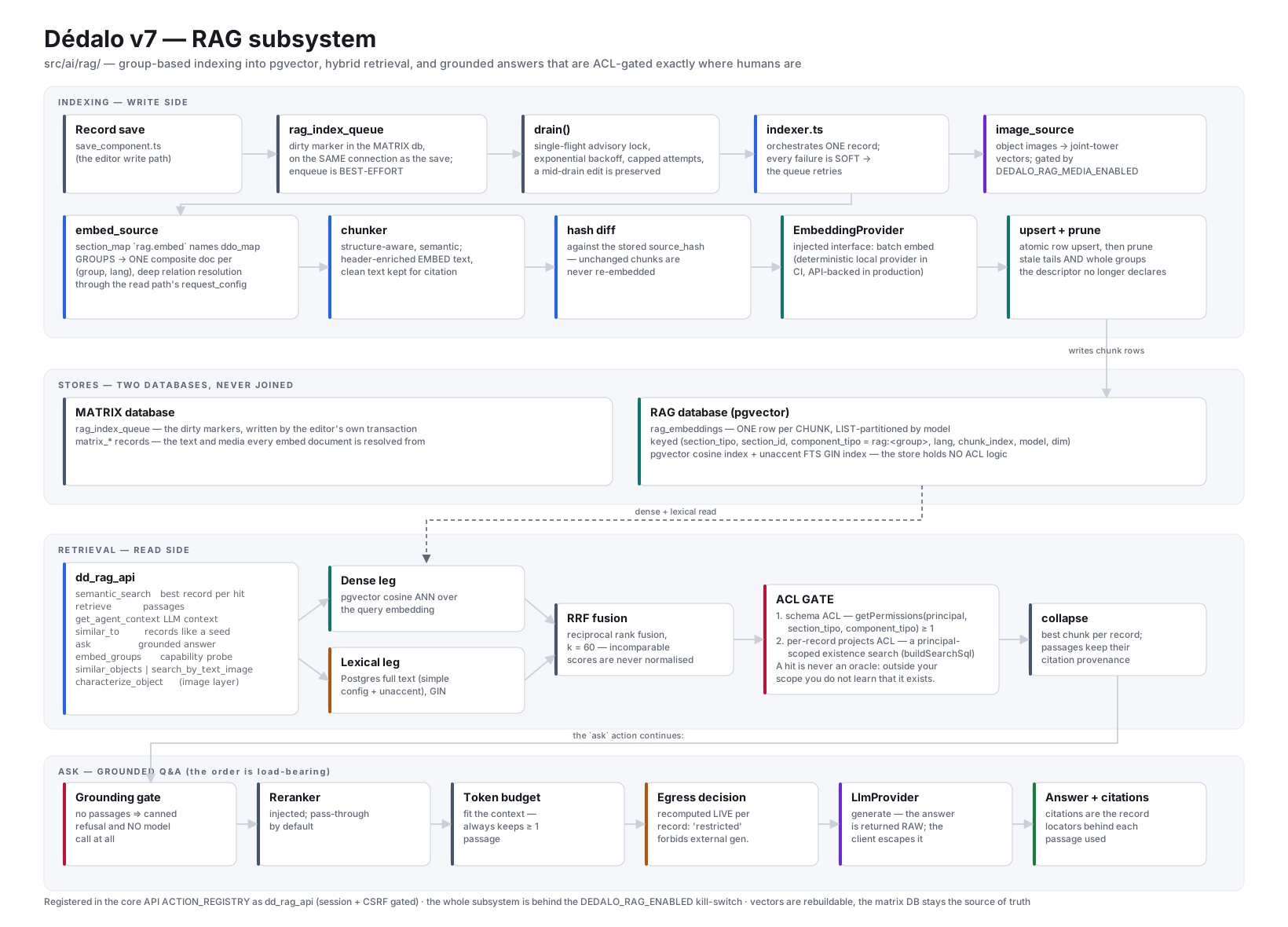
Click the diagram to open it full size.
flowchart TB
    save["save_event.ts save/delete hook<br/>(registerRagRecordHook)"] -->|"enqueue marker (best-effort)"| Q[("rag_index_queue<br/>(matrix DB, dedalo7_mib)")]
    Q -->|cli/rag_drain.ts, advisory-lock single-flight| IDX["RagIndexer<br/>(indexer.ts)"]
    IDX -->|"resolveEmbedDocs: group ddo_maps via emitDdoData<br/>(system scope, READ-ONLY)"| EX["embed_source.ts"]
    IDX -->|structure-aware chunking per group| CH["chunker.ts"]
    IDX -->|embed changed chunks only| EP["EmbeddingProvider<br/>(deterministic hash / sidecar)"]
    IDX -->|atomic upsertEmbeddingRows| VS[("dedalo7_rag pgvector store<br/>rag_embeddings, per-model partitions")]
    API["dd_rag_api (ragApiActions)"] --> RET["retrieval.ts"]
    RET -->|denseSearch: pgvector cosine ANN| VS
    RET -->|lexicalSearch: Postgres FTS + f_unaccent| VS
    RET -->|"fuse: RRF (fusion.ts) → aclGate"| ACL["getPermissions (schema) +<br/>buildSearchSql filter_by_locators (per-record)"]
    RET -->|records or passages| API
    API -->|"ask: runAsk (ask.ts)"| LLM["LlmProvider<br/>(HttpLlmProvider / StubLlmProvider)"]
Two Postgres databases, bridged by a locator/passage list, never a join: the matrix (dedalo7_mib, wherever config.db points) holds the dirty-marker queue and is the ACL source of truth; a separate database (dedalo7_rag by default, overridable via DEDALO_RAG_DB_NAME/RAG_DB_NAME, reusing the matrix host/user/password from config.db) holds only vectors and is fully rebuildable. ACL is enforced explicitly inside retrieval.ts's aclGate/aclFilterCandidates — never inside the store — as a two-step check per candidate: (1) schema ACL — getPermissions(principal, sectionTipo, componentTipo) >= 1 for per-component chunks (the image path), and getPermissions(principal, sectionTipo, sectionTipo) (section-level read) for rag:<group> facet chunks, whose document composes several components; (2) per-record projects ACL, a principal-scoped existence probe built with buildSearchSql({ filter_by_locators: […] }), so a hit a non-admin's project scope excludes is dropped before any score or count leaves the server (never an existence oracle).
Gap. The
rag_embeddingsparent table and itsrag_create_model_partition(model, dimension)SQL function (which provisions each model's typed column, HNSW index, and theunaccent/f_unaccentlexical index) are not self-provisioning in this tree — unlike the matrix-side queue table, whichensureRagQueueTable()creates on demand, thededalo7_ragschema must already exist before the store, indexer, or tests can run against it. Provisioning is a one-off out-of-band step, applied from the DDL vendored atinstall/db/rag_embeddings.sql(idempotent;bun run test:db:setupapplies the same file when it builds the suite's own vector database, so the two cannot drift).
Enabling RAG
- Provision the vector store. A separate PostgreSQL with the
vectorextension, database namededalo7_ragby default (DEDALO_RAG_DB_NAME/RAG_DB_NAMEin../private/.envoverride the name; host/user/password are the same matrix credentials,config.db). Provision therag_embeddingsparent table and itsrag_create_model_partition()function withpsql -d dedalo7_rag -f install/db/rag_embeddings.sql— see the gap noted above. - Choose an embedding provider. The default, zero-config provider is
DeterministicHashProvider— a deterministic, offline bag-of-words hasher (src/ai/rag/embedding_provider.ts) that makes the whole index→retrieve pipeline testable with no network and no keys, but is not a semantic model. For real semantic retrieval, setDEDALO_RAG_EMBEDDING_PROVIDER=sidecarplusDEDALO_RAG_EMBEDDING_ENDPOINT(and optionallyDEDALO_RAG_EMBEDDING_MODEL, defaultbge-m3) to point at an HTTP embedding sidecar speakingPOST {endpoint}/embed {model, input:[…]} → {embeddings:[…]}. - Opt records in, via the section's
section_mapragscope (2026-07-22 — the embed groups descriptor, resolved byRagConfig.getEmbedGroups,src/ai/rag/config.ts; the earlier per-node boolean flags are retired). A section'ssection_mapontology node — the section's global "how to interpret me" contract, already used for its Term/parent roles — gains aragkey whoseembedis an array of named groups, each an exact request_configddo_map: - A group = one vector document per (record, data-lang), stored under
component_tipo = 'rag:<id>'. Groups are the facet unit: a person section can declare separateprofessionandfiliationgroups (independent vectors, so a profession query is not diluted by filiation text), and a 100 KB transcription gets its own group with its own chunking. - Selection is per (virtual) section, not per shared component.
getSectionMapis virtual-aware (a virtual section's ownsection_mapnode wins, else the real section's viarelations[0].tipo), so two virtual siblings sharing components can embed different combinations — impossible under the old component-node flag, which also indexed zero text for virtual sections (the selection walk was not virtual-aware). - Deep resolution is inherited, not bespoke: each group's
ddo_mapis resolved through the SAMEemitDdoDatamachinery as the human section read (src/ai/rag/embed_source.ts), so a relation entry (a mint) resolves to its target's term text — and explicit child ddos reach arbitrary depth, exactly as inrequest_config. - Record coherence: every group always embeds its FULL definition under the system index-time scope (
RAG_SYSTEM_PRINCIPAL+ explicit per-doc data lang — guarded byrag_index_scope_tripwire), regardless of which user's save triggered the re-index. Retrieval gatesrag:chunks at the record level (section read permission + per-record projects ACL): the record is the access unit for semantic search. - Switch it on:
DEDALO_RAG_ENABLED = true. This both letsdd_rag_apiactions run and registers the save/delete hook (initRagHooks(),src/ai/rag/bootstrap.ts, called once fromstartServer()) that enqueues a dirty marker intorag_index_queueon every write. - Backfill and drain — see Operations below.
- (Optional) object images — declare
properties.rag.contexton the section node (images + views, and the typology/period/material components — see below; the image layer still reads the node'sproperties, not the section_map), stand up the multimodal sidecar (DEDALO_RAG_MULTIMODAL_*), and setDEDALO_RAG_MEDIA_ENABLED = true. Gap: only the retrieval side of the image layer is built; there is no automated ingestion path yet that reads a record's images off disk and embeds them into the store (see Image similarity & object characterization below).
Example section_map properties.rag for a publication section (a card facet plus a full-text facet):
{
    "rag": {
        "embed": [
            { "id": "card",
              "ddo_map": [
                  { "tipo": "rsc140", "section_tipo": "self" },
                  { "tipo": "rsc221", "section_tipo": "self" },
                  { "tipo": "rsc138", "section_tipo": "self" },
                  { "tipo": "dd812", "section_tipo": "dd810", "parent": "rsc138" }
              ] },
            { "id": "fulltext",
              "ddo_map": [ { "tipo": "rsc210", "section_tipo": "self" } ],
              "mode": "long_document",
              "chunk": { "max_tokens": 450, "min_tokens": 120 } }
        ],
        "strategy": "structural_semantic",
        "system_prompt": "Answer as a publications archivist."
    }
}
The dd812 entry is the deep case: rsc138 is a relation, and its child ddo resolves dd812 in the target section dd810 — the target's text lands in the host record's card document (its origin is recorded in chunk_meta.contributors, which the ask egress gate also checks so a forbidden section's text can never egress through a host record). Retrieval takes an optional group option to scope any search to one facet.
The API (dd_rag_api)
Registered in the static action registry (src/core/api/dispatch.ts → ragApiActions), so login/CSRF/session gating is inherited from the same dispatch chokepoint every other API class goes through. Every action reads rqo.options and returns the standard envelope v2 success — { status: 200, body: { ok: true, request_id, msg, data } }, the payload in data and the RAG outcome token msg riding as an extension key; a refusal is a coded THROW, never an ok:true body. Each handler resolves the caller's Principal first (resolveCaller) and declines with auth.not_logged if there is none; every action declines with rag.disabled (disabled()) unless DEDALO_RAG_ENABLED is on — except embed_groups, which answers {groups: []} instead (see below).
Actions: semantic_search, retrieve, get_agent_context, similar_to, ask, embed_groups (a section's embed-group ids — the client's facet selector and semantic-availability gate; empty for RAG-off/malformed/denied/not-opted-in alike, never an existence oracle and never a red alert on an install without RAG), and (images, additionally gated by DEDALO_RAG_MEDIA_ENABLED) similar_objects, search_by_text_image, characterize_object.
Who may spend, and how much. Every action that calls a model is metered against the caller's daily AI limits (a per-user, per-UTC-day ledger in the AI usage section under Administration, dd660; src/core/security/ai_spend.ts) after its request is validated and before the model is touched: one query embedding for semantic_search, retrieve, get_agent_context and search_by_text_image; one model run, its token reservation (the context budget plus the output cap) and one query embedding for ask. A used-up budget is 429 ai.budget_exhausted, with the budget's kind, its limit and when it resets; a ledger that cannot be used refuses 503 ai.budget_unavailable (never an unmetered spend). ask is a generated answer and additionally needs the tool_rag grant (403 tool.not_authorized without it, before anything is read); a grounding miss refunds its run. similar_to, similar_objects and characterize_object reuse stored vectors, call no model and spend nothing; embed_groups is the capability probe. The limits are data on the caller's user and profile records (the AI usage group: user value, else profile value, else 0, each kind on its own — AI spend limits); nobody is exempt.
A limit is clamped to [1, 50], default 10 (clampTopK, MAX_TOP_K = 50). An optional section_tipo scope accepts a single string or an array of strings (optionScope) — pushed down into both store legs (recall) AND re-applied at the ACL gate, never a substitute for it. An optional group (slug) narrows to one embed facet's chunks. The CLIENT search UI consumes semantic_search through the resolve-once-then-pin flow: ranked hits become sqo.filter_by_locators pins plus the {mode:'locator_position'} order entry, so the normal section list renders them in relevance order (WC-047).
Semantic search — text → ranked records (RagSearchHit[], from semanticSearch(), src/ai/rag/retrieval.ts):
// request
{
    "dd_api": "dd_rag_api",
    "action": "semantic_search",
    "options": {
        "query": "displacement caused by the building of the reservoir",
        "section_tipo": ["oh1"],
        "limit": 8
    }
}
// response.body.data (record-level, ACL-filtered, best-first)
[
    { "section_tipo": "oh1", "section_id": 412, "component_tipo": "oh23", "lang": "lg-spa",
      "snippet": "…cuando llegó el agua tuvimos que marcharnos…", "score": 0.031 }
]
retrieve and get_agent_context call the same hybrid pipeline (retrievePassages()) but return passages (chunks, not collapsed to records) — each hit is a RagSearchHit plus chunk_index, for chat/agent grounding.
Ask — grounded answer with citations (runAsk(), src/ai/rag/ask.ts):
// request
{ "dd_api": "dd_rag_api", "action": "ask",
  "options": { "query": "What do informants say about losing farmland to the dam?",
               "section_tipo": ["oh1"] } }
// response.body.data
{
    "answer": "Several informants describe being forced to leave when the reservoir flooded their fields…",
    "citations": [ { "locator": "oh1-412", "sectionTipo": "oh1", "sectionId": 412, "citedText": "…" } ],
    "provenance": [ { "section_tipo": "oh1", "section_id": 412, "component_tipo": "oh23", "lang": "lg-spa",
                      "chunk_index": 3, "text": "…cuando llegó el agua tuvimos que marcharnos…", "score": 0.031 } ],
    "grounded": true,
    "used_provider": "stub",
    "model": "stub-llm"
}
If no permitted, relevant context is found, runAsk returns refusalResult() — grounded: false, citations: [], provenance: [], used_provider: '' — and makes no model call; the envelope's msg becomes no_grounded_context instead of ok. A thrown transport/protocol error from the LlmProvider maps to a generation_failed envelope (never a fabricated answer). The answer is returned as raw text in JSON (transport-safe); the client escapes it at render.
There is a fourth outcome, the egress-gated refusal (RESTRICTED_MSG = 'external_generation_restricted', restrictedResult()): at least one grounding passage is a restricted-egress record (a forbidden host or contributing section, or external generation globally off) and no local non-egressing provider is wired, so runAsk makes no external model call and returns grounded: false, restricted: true, citations: []. Unlike the grounding refusal it keeps provenance — the withheld sources — so the caller can show what was suppressed rather than pretending nothing matched. The restricted? field on AskResult flags this reason.
similar_to takes { section_tipo, section_id, group? } and returns nearest-neighbour records (the seed excluded), reusing the seed's already-stored vectors — it never re-embeds the seed. With group, both the seed's vectors and the neighbours narrow to that facet ("similar by profession").
Ingestion pipeline (text)
The save/delete hook (registerRagRecordHook, wired by initRagHooks()) enqueues a dirty marker (best-effort — swallows every error; a down vector store can never fail a save). The drain CLI (bun run src/ai/rag/cli/rag_drain.ts, or RagQueue.drain() directly) processes markers out-of-band, single-flighted by a Postgres advisory lock (pg_try_advisory_lock) so it's safe to run from cron on every worker:
- Resolution (
embed_source.ts,resolveEmbedDocs) — reads the matrix record ONCE, then resolves each embed group'sddo_mapthrough the read path's ownemitDdoData(deep relation resolution included) into one composite document per(group, data-lang), entries joined in map order under## {component label}headers, values flattened to plain text (htmlToPlainText). Every resolution runs inside the SYSTEM index-time scope —RAG_SYSTEM_PRINCIPAL+ the explicit per-doc data lang (runWithRequestContext/runWithRequestLangs, guarded byrag_index_scope_tripwire) — so the document never depends on who saved. Mode rule: an explicit ddomodeis honored verbatim; an absent one defaults literal→edit(full value —listwould apply the 130-char text_area list-preview truncation) and relation→list(compact target-term resolution). A lang-sensitive group (any translatable or relation entry) resolves once per configured data lang; a lang-independent one only inDATA_NOLAN. Empty documents prune their stored chunks on the next drain; each document records itscontributors(component + target section tipos) intochunk_meta. - Chunking (
chunker.ts,chunk()) — structure-aware semantic chunking: - Structural hard boundaries —
[h1]…[h6]heading lines, blank-line paragraphs, page markers[page-n-N], and transcription turns[TC_HH:MM:SS(.mmm)_TC]; a chunk never crosses one. Text and timecoded-transcription inputs are auto-detected (detectMode) or set explicitly (mode: 'short'|'transcription'|'long_document'). - Semantic soft boundaries — with an injected sentence embedder, adjacent sentences are compared and split where cosine distance exceeds a percentile threshold (default the 92nd,
breakpointThreshold); with no embedder this degrades cleanly to structural-only. The production indexer currently injects none (the seam is synchronous; wiring the async sidecar needs a chunker refactor), so deployed chunking today is structural boundaries + sentence-aligned packing. - Pack + orphan absorption — segments are packed toward
maxTokens(default 450) with aminTokensfloor (default 120); a trailing chunk below the floor merges back into its predecessor. - Contextual enrichment —
"{document title} › {heading path}\n{raw text}"is embedded; the cleanraw textalone is stored for citation. - Small-to-big — each chunk carries a
parentKey(its structural section's hash, or anav:{mediaTipo}key for a transcription) for a future parent-expansion step (not yet wired intoask()— see the ledgered simplification below). AsourceHash = sha256(CHUNKER_VERSION '|' embedText)versions the algorithm: bumpingCHUNKER_VERSIONforces every chunk to re-embed. - Indexing (
indexer.ts,RagIndexer.indexRecordText) — chunks each group document under the group'schunk/mode/strategyconfig and stores rows undercomponent_tipo = 'rag:<group>'; diffs each chunk's hash against the storedsource_hash(diffHashes) so unchanged chunks never re-embed — editing one group's source re-embeds only that group; embeds only the changed ones (soft-fails to a retryablefalseon any read/embed/store error, never throwing); flushes the changed rows plus stale-tail pruning atomically (upsertEmbeddingRows/deleteStale) — embedding happens outside the transaction, the write is atomic. An orphan sweep prunes stored(component_tipo, lang)pairs the current descriptor no longer produces, so renamed/removed groups and dropped languages self-heal on the next index. - Storage (
vector_store.ts) —rag_embeddingsin the separatededalo7_ragdatabase, partitioned by model (ensureModelPartitionTyped/rag_create_model_partition, one typedvector(N)column + HNSW cosine index per partition — see the provisioning gap above).
Ledgered simplification. ask()'s small-to-big parent expansion is not implemented: the dense/lexical retrieval legs don't currently project parentKey back out, so expanding a hit to its parent section would be a no-op. Add it when the retrieval legs surface parentKey.
Retrieval pipeline
retrieval.ts runs the hybrid search and gates every hit before it can leave the server:
- Hybrid candidates (
hybridCandidates) — dense ANN (denseSearch, pgvector cosine distance) and lexical full-text (lexicalSearch, Postgresto_tsvector('simple', f_unaccent(…))— accent-folded so pantano and pantáno both match) run in parallel, each over-fetchingmax(limit*4, 20)candidates, then merge via Reciprocal Rank Fusion (fuse(),fusion.ts,k=60, one map keyed on the chunk identity). An optionalgroupnarrows both legs to one facet's chunks (component_tipo = 'rag:'+group). Hybrid catches proper nouns, inventory numbers and archival signatures pure-vector retrieval misses. - Rerank — a
Rerankerseam (reranker.ts) sits between fusion and the token-budget fit in theask()path; the shippedPassThroughRerankerreturns the fused order unchanged (contract: reorder only, never drop/add). No cross-encoder is wired yet. - Explicit ACL (
aclGate, module-header chokepoint ofretrieval.ts) — for every candidate, in order: (1) schema ACL — per-component for image-path chunks; for arag:<group>facet chunk, per contributing component — the group document is composed at index time under the system principal, so it embeds the text of every component in the group's ddo_map, and the gate requiresgetPermissions(principal, sectionTipo, componentTipo) ≥ 1for the section read grant AND for every host-section component recorded inchunk_meta.contributors(drop on any level 0; an empty contributor set fails closed). This is the exact parity of the human read's per-component gate, so a role that holds level 0 on a component never matches its text through a group chunk. Memoised per key; (2) per-record projects ACL, a principal-scoped existence probe (buildSearchSqlwithfilter_by_locators), memoised per(sectionTipo, sectionId)— before any score or count is returned, for every action (never an existence oracle). - Shape —
semantic_search/similar_tocollapse the gated candidates to the best-scored chunk per record (collapseToRecords);retrieve/get_agent_context/askkeep every gated passage (retrievePassages).
Generation (ask)
ask()'s LlmProvider seam (llm_provider.ts) is pluggable via DEDALO_RAG_LLM_ENDPOINT: when set, HttpLlmProvider posts an OpenAI-compatible chat-completions request (works against any local TEI/vLLM/llama.cpp endpoint or a hosted OpenAI-compatible API, model/timeout/temperature from DEDALO_RAG_LLM_*); when unset, the deterministic StubLlmProvider answers with a templated, self-citing echo of the retrieved passages — so ask() is fully exercisable offline with no model running. (This is a different provider seam from the agent loop's Anthropic integration below — ask() does not currently have an Anthropic-native adapter.) The pipeline (runAsk, load-bearing order): retrieve (ACL enforced inside) → grounding gate (no passages ⇒ refuse, no model call) → rerank (pass-through) → fitTokenBudget (keeps ≥1 passage even over budget) → a live egress decision recomputed per record from current config (buildEgressPolicy: a DEDALO_RAG_EXTERNAL_PROVIDER_FORBIDDEN_SECTIONS section, or DEDALO_RAG_ALLOW_EXTERNAL_PROVIDER_DEFAULT being off, forces 'restricted'; the policy also accepts an optional per-record publishable() callback, not currently wired by dd_rag_api, so today the decision is global, not yet keyed off each record's actual diffusion-publish status) → generate. The system prompt resolves the section_map rag.system_prompt first, then the section node's properties.rag.system_prompt (legacy home), then DEDALO_RAG_LLM_SYSTEM_PROMPT, then a safe built-in default (buildSystemPromptResolver).
Image similarity & object characterization
For object collections (coins, amphorae, ceramics, …) the retrieval side of an image layer is built: ObjectRetrieval (object_retrieval.ts) and RagCharacterizer (characterizer.ts) answer object-centric questions over image vectors already present in the store (modality: 'image' rows). A section opts in through properties.rag.context (RagConfig.getContext), which declares — in the ontology, per section (archaeology ≠ oral history) — which image components carry the visual signal (and their view, e.g. obverse/reverse), and which components are the typology / period / material:
{ "rag": { "context": {
    "images":   [ { "tipo": "numd5", "view": "obverse" }, { "tipo": "numd6", "view": "reverse" } ],
    "metadata": { "typology": "numd10", "period": "numd20", "material": "numd30" },
    "compare_scope": ["numisdata4"]
  } } }
Capabilities (all ACL-filtered via aclFilterCandidates; results carry the neighbour's stored thumb_url from chunk_meta):
similar_objects(findSimilarObjects) — "objects close to this one". Reads the seed's stored image vectors (no re-embedding) and finds the visually nearest others. A multi-image object (a coin's obverse + reverse) fuses the per-view result lists with RRF, so an object close on both faces ranks above one close on a single face.mode: 'hybrid'(default) adds a lexical leg over the stored context summary (the seed's ownsource_text) — essential for heritage, where pure visual similarity confuses a bronze coin with a bronze button;mode: 'visual'skips it. Anear_duplicate: truerequest floors results atDEDALO_RAG_NEAR_DUPLICATE_SIMILARITY(default0.93).search_by_text_image(searchByTextImage) — a textual description → matching object images, encoded through the multimodal model's text tower (embedTextForImageSearch— never the plain textEmbeddingProvider, which lives in an unrelated vector space).characterize_object(RagCharacterizer.characterize) — the "describe the object by its relatives" capability, with no LLM involved: retrieve the nearest neighbours (findSimilarObjects) then, for each declared metadata role, read every neighbour's value through that neighbour's ownproperties.rag.context.metadatamapping (RoleReader,role_reader.ts) and aggregate: a similarity-weighted vote over categorical roles (typology/material —aggregateCategorical, winner = highest-weight value, confidence = its share) or an earliest…latest range + weighted-central estimate for a date role (period —summarizeDates, confidence =1 - midpoint-spread/span). Each proposal carries a confidence and cited evidence (top-8-by-weight supporting neighbours, with thumbnails). No generative guess: a coin's typology is proposed from real cataloged coins, verifiably.
The multimodal provider seam (multimodal_embedding_provider.ts) mirrors the text one: SidecarMultimodalProvider speaks POST {endpoint}/image {model, images:[base64,…]} / POST {endpoint}/text {model, input:[…]} → {embeddings:[…]} (falls back to tolerating an OpenAI-style {data:[{embedding}]} shape) when DEDALO_RAG_MULTIMODAL_ENDPOINT is set; otherwise a deterministic, network-free DeterministicMultimodalProvider keeps the image pipeline exercisable offline. isExternal() reports non-'local' providers, and that is what the egress gate keys off: buildMultimodalProvider refuses to construct an external provider unless DEDALO_RAG_IMAGE_EGRESS_POLICY is allow_external — the institution's own switch, closed by default, so object images cannot leave the host through an oversight in a settings file. It refuses loudly rather than falling back to the deterministic provider, which would keep indexing and write meaningless vectors under a real model's name.
Gap — no image ingestion pipeline yet. RagIndexer (indexer.ts) only extracts and embeds text; its own header notes "The IMAGE/multimodal path is a later brick and is not built here". There is no code that reads a record's declared context images off disk, downsizes/embeds them, and writes modality: 'image' rows on save — embedImage() is exercised only by test/unit/rag_multimodal.test.ts. similar_objects/search_by_text_image/characterize_object are real, ACL-gated, and tested against hand-inserted vectors, but a deployment cannot yet catalog a new coin's photographs into the store through an ordinary save the way it can for text.
Agent loop & MCP
Two more surfaces expose the same ACL-gated core to an LLM, sharing the read/write handlers in src/ai/mcp/tools.ts — a section/record the configured user cannot see is invisible to either:
- MCP server (
src/ai/mcp/server.ts,@modelcontextprotocol/sdk, stdio transport) — a thin transport shell with no business logic of its own:buildMcpServer(principal, { allowWrite })exposes the full sharedTOOL_REGISTRY(src/ai/mcp/registry.ts) under its gates — the read tools always on, the write tools only whenDEDALO_MCP_ALLOW_WRITE=true. Reads:dedalo_search_records,dedalo_count_records,dedalo_search_section,dedalo_read_record,dedalo_describe_node,dedalo_list_sections,dedalo_describe_section,dedalo_resolve,dedalo_resolve_path,dedalo_get_media_info. Writes:dedalo_save_component,dedalo_create_record,dedalo_delete_record,dedalo_set_field,dedalo_portal_link,dedalo_portal_unlink,dedalo_find_or_create,dedalo_duplicate_record,dedalo_upload_media. The principal is resolved once at startup fromDEDALO_MCP_USER_ID(add128usersection_id, or-1for the superuser in trusted local dev) and is fixed for the process lifetime — there is no tool to change identity, and a missing/invalid id is a hard startup error (fail-closed, never a silent privileged fallback). Every write tool re-checksgetPermissions(...) >= 2server-side and goes through the samesaveComponentData/createSectionRecord/deleteSectionRecordengines (and Time Machine audit) the human save/create/delete actions use — an LLM acting through MCP can never write where its configured user could not through the web client. - Agent loop (
src/ai/agent/loop.ts,runAgent()) — a manual tool-use loop (capped at 12 turns,MAX_ITERATIONS) over the same shared registry handlers MCP exposes plus RAG'ssemanticSearch()/retrievePassages(), each tool call executed under the caller'sPrincipalso a failed/denied call becomes anis_errortool result the model can adapt to rather than a privilege escalation. Its tool surface (AGENT_TOOLS) is the full MCP read registry (registeredTools()) plus RAG'sdedalo_semantic_searchanddedalo_retrieve_passages, and is provider-neutral (AgentLlmProvider,agent/llm_provider.ts): production wires the official@anthropic-ai/sdk(AnthropicProvider, modelclaude-opus-4-8by default, override viaAGENT_MODEL) and fails closed — constructing it withoutANTHROPIC_API_KEYthrows, so the agent can never silently run keyless; the offline test gate (agent_loop.test.ts) drives the loop with a deterministic scripted provider instead, asserting the same scripted trajectory returns real data for an authorized principal and nothing for a denied one.
Both are read-only by default and additive on top of dd_rag_api — the MCP/agent tools do not bypass or duplicate the human API's dispatch, they call straight into the same engines it does.
Operations
- Drain (required). Wire the CLI to cron — without it, markers never index:
It no-ops cleanly (logs and exits 0) when
* * * * * cd /path/to/dedalo-ts && bun run src/ai/rag/cli/rag_drain.ts >> /var/log/dedalo/rag_drain.log 2>&1DEDALO_RAG_ENABLEDis off; it is safe to overlap (single-flighted bypg_try_advisory_lock, key918273645). A failing record backs off exponentially (2^attemptsminutes, capped at 30) and is dropped afterDrainOptions.maxAttempts(default 5). - Backfill. No dedicated CLI yet — drive
RagIndexer.indexRecordText(locator)(buildRagIndexer()) over a section's ids directly, or enqueue them viaRagQueue.enqueue()and let the drain process them. - Monitoring.
RagQueue.stats()reports{ pending, ready, blocked, failed, oldestAgeSec }overrag_index_queue. - Reconcile.
RagIndexer.reconcileSection(sectionTipo, matrixIds, enqueue)diffs matrix-side ids againstlistSectionIds()(the vector store's distinctsection_ids) and enqueuesindex/deletecorrections for the drift — the matrix id source and the enqueue callback are both injected, so this is wired per-caller rather than a standalone CLI.
Extending
- Embedding provider — implement the
EmbeddingProviderinterface (embedding_provider.ts:name,model,dimension,embed(texts));getEmbeddingProvider()resolvesDeterministicHashProviderby default orSidecarEmbeddingProviderwhenDEDALO_RAG_EMBEDDING_PROVIDER=sidecar. Dimension is discovered from the response, never hard-coded. - Reranker — implement
Reranker.rerank(query, passages)(reranker.ts) and wire it in place ofPassThroughRerankerinaskAction(api.ts); no cross-encoder ships yet, and there is noDEDALO_RAG_RERANK_ENDPOINTconfig surface in this tree. - System prompt — global
DEDALO_RAG_LLM_SYSTEM_PROMPTor per-section section_maprag.system_prompt(nodeproperties.rag.system_promptas legacy fallback;buildSystemPromptResolver).
Configuration & tests
Every DEDALO_RAG_* (and the shared APPLICATION_LANGS/DATA_NOLAN/ANTHROPIC_API_KEY/AGENT_MODEL/DEDALO_MCP_*) setting is read directly via readEnv() at the point of use (src/config/env.ts: real process env, then ../private/.env). The image layer's keys are also declared in the config catalog (src/config/catalog/ai.ts), which is what puts them in install/sample.env and in the generated settings reference (docs/config/config.md), and what makes the config census fail if one is added without an operator-facing entry; the ask/LLM keys are not declared there yet, so each of those modules' header comments is still the only place they are described. The full set actually referenced: DEDALO_RAG_ENABLED, DEDALO_RAG_DB_NAME/RAG_DB_NAME, DEDALO_RAG_EMBEDDING_PROVIDER/_ENDPOINT/_MODEL, DEDALO_RAG_CONTEXT_TOKEN_BUDGET, DEDALO_RAG_ALLOW_EXTERNAL_PROVIDER_DEFAULT, DEDALO_RAG_EXTERNAL_PROVIDER_FORBIDDEN_SECTIONS, DEDALO_RAG_LLM_ENDPOINT/_MODEL/_API_KEY/_TEMPERATURE/_TIMEOUT/_MAX_OUTPUT_TOKENS/_SYSTEM_PROMPT, DEDALO_RAG_MEDIA_ENABLED, DEDALO_RAG_MULTIMODAL_PROVIDER/_MODEL/_ENDPOINT/_API_KEY, DEDALO_RAG_IMAGE_EGRESS_POLICY, DEDALO_RAG_IMAGE_MAX_PX/_HYBRID, DEDALO_RAG_NEAR_DUPLICATE_SIMILARITY, DEDALO_RAG_CHARACTERIZE_TOP_K.
Tests live under test/unit/ and run with bun test:
bun test test/unit/rag_chunker.test.ts \
  test/unit/rag_fusion.test.ts \
  test/unit/rag_config.test.ts test/unit/rag_indexer.test.ts test/unit/rag_queue.test.ts \
  test/unit/rag_ask.test.ts test/unit/rag_api.test.ts test/unit/rag_multimodal.test.ts \
  test/unit/mcp_tools.test.ts test/unit/mcp_write_tools.test.ts test/unit/agent_loop.test.ts
Pure-logic tests (chunker structure/semantic boundaries, RRF fusion, config resolution, the ask grounding/refusal/egress gates, the multimodal joint-space math) run fully offline with no keys or network. Two further cross-check test files pin the chunking and RRF math against a frozen historical set of numeric test vectors, for algorithmic confidence — everything else in the doc above is fresh TS design. test/unit/rag_store.test.ts, rag_queue_integration.test.ts, and rag_pipeline.test.ts run end-to-end against real databases — but never an installation's: the suite runs on the matrix suite database and, since P1-16 (2026-08-30), on its OWN vector database <suite db>_rag, which test/preload/rag_db.ts provisions and repoints to unconditionally via DEDALO_TEST_RAG_DB_NAME, and which every vector WRITE door refuses unless it carries the dedalo_test_rag_marker row (a disposable model/section per run, cleaned up in afterAll) — the DoD assertion in rag_pipeline.test.ts is that a denied principal gets nothing back from the same query a superuser gets real hits from. mcp_tools.test.ts/mcp_write_tools.test.ts assert the MCP handlers apply the exact same ACL/permission gates as the human API; agent_loop.test.ts drives the same scripted trajectory through a denied and an authorized principal and asserts the difference.
Testing it end-to-end (as a user). With DEDALO_RAG_ENABLED=true and the default deterministic providers, no external services are required: index a couple of records — either save them through the engine with the hook armed (DEDALO_RAG_ENABLED=true makes initRagHooks() register it) and then drain the markers (bun run src/ai/rag/cli/rag_drain.ts), or index them straight away with buildRagIndexer().indexRecordText({ sectionTipo, sectionId }) — then call semantic_search/ask through dd_rag_api. To drive it as an agent, run the MCP server (DEDALO_MCP_USER_ID=<user id> bun run src/ai/mcp/server.ts, add DEDALO_MCP_ALLOW_WRITE=true for the write tools) against any MCP client, or run the agent loop (runAgent(), src/ai/agent/loop.ts) with the production AnthropicProvider (requires ANTHROPIC_API_KEY; model claude-opus-4-8 by default, override via AGENT_MODEL) — its tool surface (AGENT_TOOLS) mirrors the full MCP read registry plus dedalo_semantic_search and dedalo_retrieve_passages. There is no reference embedding/image sidecar, rag_selftest, or rag_backfill CLI in this tree; the sidecar HTTP contracts above are the integration point for standing one up.
Part VI — Limits, ethics, and the road ahead
What RAG is not
- Not a source of truth. The matrix remains authoritative; vectors are a derived, rebuildable index.
- Not an oracle. A language model can still be wrong. RAG mitigates this by grounding answers in real records, citing every claim, and refusing when there is no evidence — but a researcher must still verify, exactly as with any secondary source. Treat the assistant as a finding aid, not an authority.
- Not a replacement for structured search. The SQO remains the right tool for exact, relational, faceted queries. RAG is for meaning; the SQO is for precision. They compose.
Ethical considerations for heritage and memory
Vectorizing heritage and memory carries responsibilities beyond the technical:
- Sensitive and restricted knowledge. Some heritage is culturally restricted, embargoed, or personal. The egress and ACL controls exist precisely so the semantic layer cannot become a back door around them. Institutions should decide deliberately what is opted in.
- Model bias. Embedding and language models carry the biases of their training data, which may misrepresent minority languages, dialects or worldviews. A multilingual default helps; vigilance and local models for sensitive collections help more.
- Provenance and consent. When testimony is involved, retrieval should point to the source in the informant's own voice (timecodes, citations) rather than paraphrase it away. The design favours linking back to the original over substituting for it.
- Interpretation stays human. The system surfaces evidence and resemblance; the meaning-making — the actual scholarship — remains the researcher's.
Roadmap
- Image ingestion on save — the nearest-term gap (Part V): a pipeline that reads a record's declared context images, downsizes and embeds them, and writes
modality: 'image'rows, sosimilar_objects/characterize_objectwork off an ordinary save the way text indexing already does. - Self-provisioning RAG schema — a TS migration for the
rag_embeddingsparent table +rag_create_model_partition(), mirroringensureRagQueueTable()'s idempotent DDL on the matrix side, so a freshdedalo7_ragdatabase needs no out-of-band setup. - Per-record egress wiring — key the
ask()/image egress decision off each record's actual diffusion-publish status (thebuildEgressPolicyseam already accepts an injectedpublishable()callback; nothing wires it todd_rag_apiyet). - Image region search & linking — query by a region of an image (a segment of a painting) and link the matching objects to that segment, building on the implemented object image similarity (Part V).
- Vision-LLM object description (optional) — a generated description grounded in the visually-similar neighbours, for the cases where the neighbour-aggregated proposal isn't enough.
- Reranking by default — a real cross-encoder behind the
Rerankerseam, in place ofPassThroughReranker. - Public semantic API — a separate service over published-only data, for third parties, co-located with the diffusion engine.
- Retrieval-quality evaluation — a golden-set harness (recall@k, citation-grounding) so model and parameter choices are measurable and regression-safe.
- Live-API smoke tests — the
AnthropicProvideragent path and a real embedding sidecar are wired but untested against live credentials in CI.
Subsystem code: src/ai/rag/, src/ai/agent/, src/ai/mcp/. Conceptual neighbours: architecture overview, SQO, exporting data, ontology.