Ready for AI — on your terms
Part of Dédalo in plain language · Previous: Three doors into the same collection · Next: The ideas behind Dédalo
Two pieces are already built into Dédalo. Both are optional, and both are switched off until an administrator turns them on.
Click the diagram to open it full size.
Semantic search: finding things by what they mean
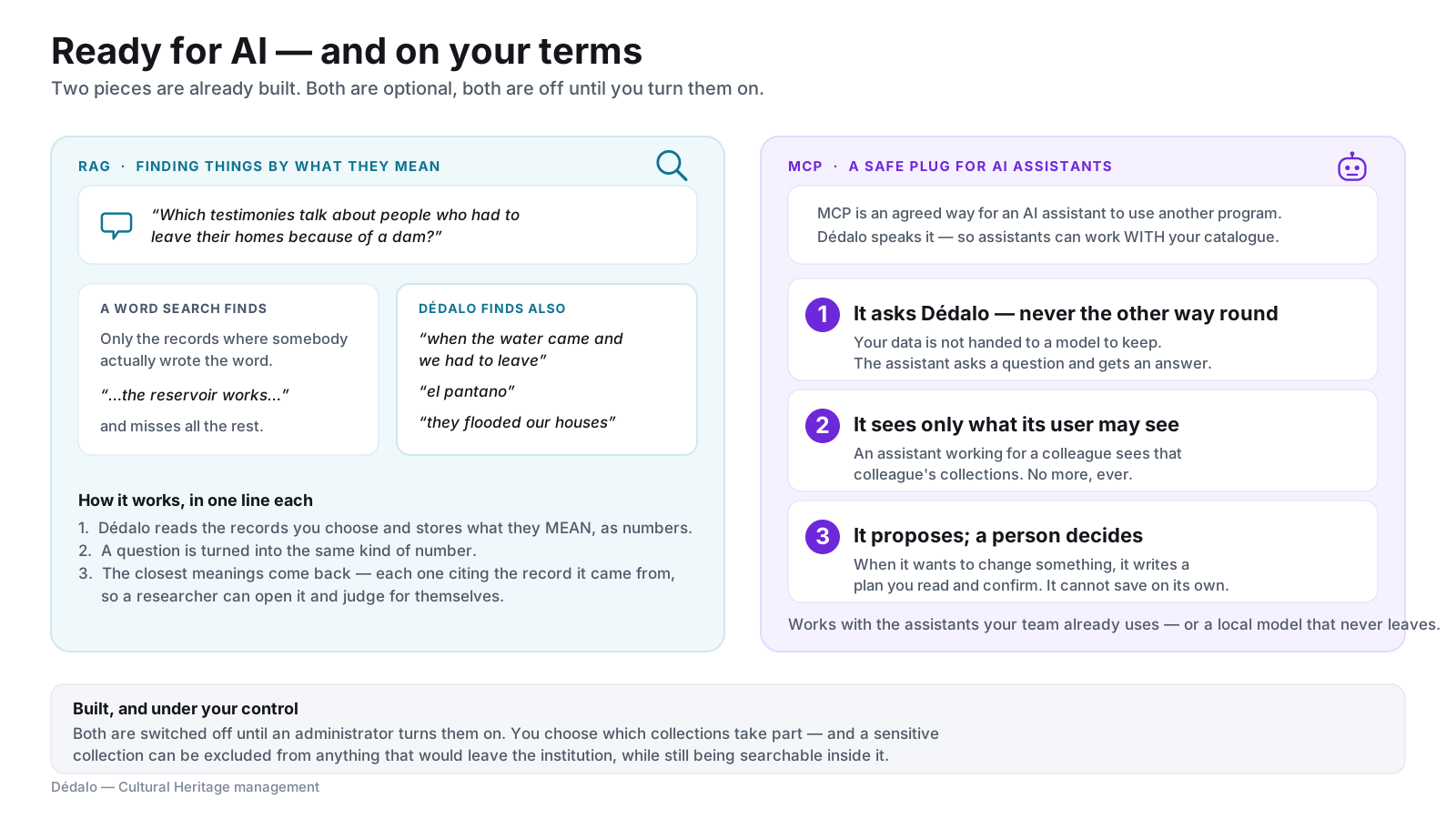
A researcher asks: which testimonies talk about people who had to leave their homes because of a dam?
A word search finds only the records where somebody actually wrote the word — "…the reservoir works…" — and misses everything else. Dédalo can also find "when the water came and we had to leave", "el pantano", "they flooded our houses", because those phrases mean almost the same thing.
How it works, in one line each:
- Dédalo reads the records you choose and stores what they mean, as numbers.
- A question is turned into the same kind of number.
- The closest meanings come back — each one citing the record it came from, so a researcher can open it and judge for themselves.
This matters for cultural heritage more than for most data, because heritage data is multilingual, historical, dialectal and paraphrastic: the same idea arrives in Spanish, Català, English, in archaic spelling, in the vocabulary of one decade or one trade. A string search asks where does this word appear? Semantic search asks what is about this idea?
It does not replace your structured search
Dédalo's precise, field-by-field search stays exactly as it is, and remains the right tool for "every coin minted before 100 BC". Semantic search is an additional way in, not a substitute — and the two are used together.
MCP: a safe plug for AI assistants
MCP is an agreed way for an AI assistant to use another program. Dédalo speaks it, so assistants can work with your catalogue instead of being handed a copy of it. Three promises hold:
1 · It asks Dédalo — never the other way round. Your data is not handed over to a model to keep. The assistant asks a question and gets an answer.
2 · It sees only what its user may see. An assistant working for a colleague sees that colleague's collections, at that colleague's permission level. No more, ever — the same checks as the staff door.
3 · It proposes; a person decides. When it wants to change something it writes a plan you read, op by op, and confirm. It cannot save on its own; the part of the system that talks to the model is structurally unable to write.
Keeping sensitive material in the building
Decide this before you switch anything on
Some collections may not leave the institution — testimony given under condition, personal data of living people, sacred or restricted material.
Dédalo lets you name those collections, and:
- they can be excluded from anything that would reach an external model, while remaining fully searchable inside the institution;
- an assistant can be pointed at a local model running on your own hardware, so no record leaves the building at all;
- both features share one classification, so a collection you restrict for search is restricted for the assistant too.
Where to read more
- RAG and semantic search — written for two readers: humanities researchers (parts I–IV, no programming) and developers.
- Talk to your catalogue — worked examples of the assistant in day-to-day curatorial work.
- Privacy and the egress gate — what may reach an external provider, and how it is enforced.
- Installing and enabling the assistant.