Where everything lives
Part of Dédalo in plain language · Next: The journey of one record
Dédalo runs in two separate places, and only one of them faces the internet. Almost every question about safety, hosting and cost has its answer in that one sentence.
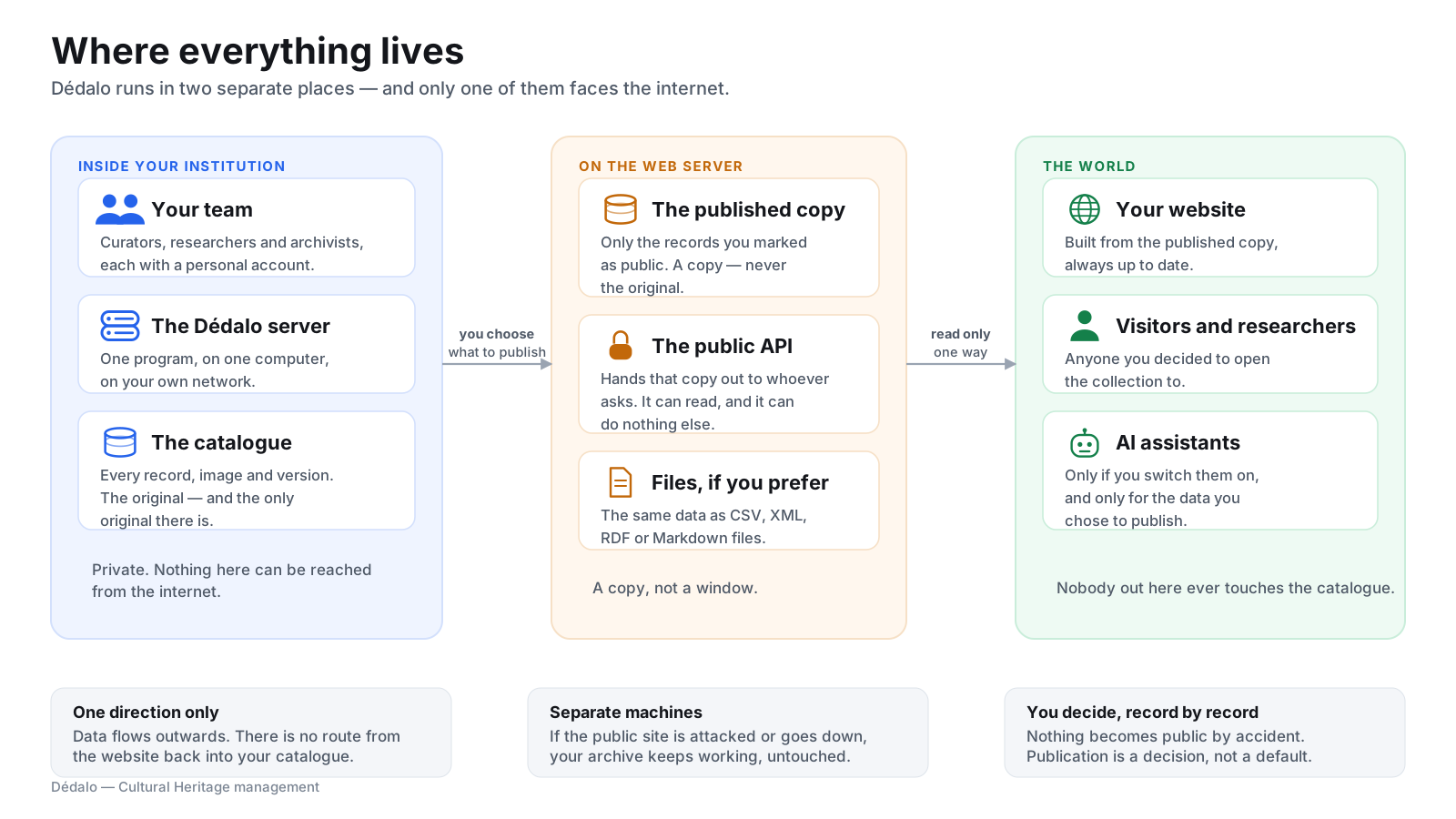
Click the diagram to open it full size.
Reading the picture
On the left, inside your institution. Your team — each person with their own account — works against one program on one computer, on your own network. Behind it sits the catalogue: every record, every image, every version. This is the original, and the only original there is. Nothing here is reachable from the internet.
In the middle, on the web server. A copy of the records you decided to make public, plus the service that hands that copy out. The same data can also be written as files — CSV, XML, RDF, Markdown — for a partner, a national aggregator or a repository.
On the right, the world. Your website, the visitors and researchers you opened the collection to, and — only if you switch it on — AI assistants.
Why this shape
One direction only
Data flows outwards. There is no route from the website back into your catalogue, because the public service has no way to write anything, to any database, ever. A visitor is not looking through a window into your archive; they are reading a copy.
The two halves can live on different machines. The public half is normally installed next to your website, on the web server; the working half stays inside the institution. They share nothing but the published copy — no password, no connection, no code.
So an incident on one side is not an incident on the other. If the public site is attacked, overloaded or simply switched off, cataloguing continues untouched. If the institution's network is down, the website keeps serving.
And nothing is public by accident. Publication is a decision taken record by record, and it can be undone — the next publication run removes what you un-marked.
Common questions
Can we run everything on one machine? Yes — a small institution often does, and the separation still holds, because it is a separation of roles, not only of hardware. Two machines is the recommendation once the site has real traffic or the collection holds material that must not leave the building.
Do we need to be online to catalogue? No. The working half needs your own network, not the internet.
Where do the big files go? Masters, derivatives and thumbnails live beside the catalogue and are served directly by the web server, not carried through the program — which is why a 32 GB video is not a problem. See the media pipeline.
Where to read more
- Architecture overview — the same picture with the technical names attached.
- Installation — sizing, prerequisites and the three installation paths.
- Diffusion — how the published copy is produced.
- Backup — protecting the original.